
Contact here for Advertising & Partnerships // Support the newsletter here.
Written by David Skilling
Every four years, brands spend enormous amounts of money trying to associate themselves with the World Cup. They build campaigns months and even years in advance, negotiate expensive partnerships and prepare for one of the biggest marketing opportunities in global sport. The assumption is simple: the closer you are to the tournament, the greater the commercial reward. For the most part, that’s true. But every now and then, football reminds us that the biggest prize isn’t just about owning the tournament. It’s owning the moments that everybody remembers.
This year’s World Cup Final produced one of those moments.
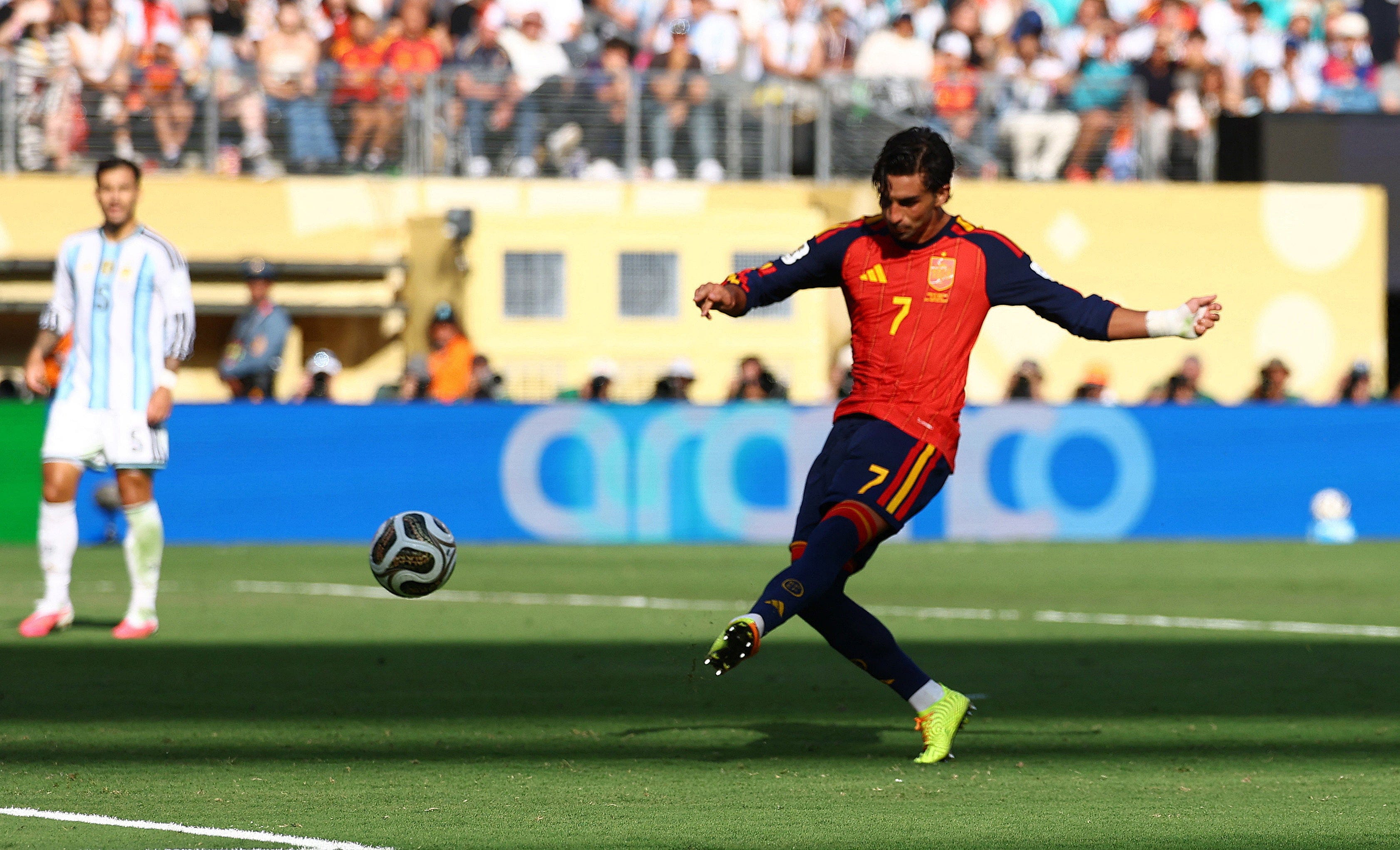
In the 106th minute, Spain’s Ferran Torres scored the goal that beat Argentina and secured Spain’s second World Cup title. It was the defining image of the tournament, the clip that will be replayed for decades whenever people look back on World Cup history. Torres came off the bench to score the winner wearing Under Armour boots, capping a remarkable turnaround after beginning the tournament as a starter before losing his place and fighting his way back into Luis de la Fuente’s plans.
For Under Armour, it was the kind of sporting moment that brands spend years hoping to experience but can never plan with certainty.
The company wasn’t an official FIFA World Cup partner. It didn’t own tournament rights or enjoy the privileges that come with them. Yet in the final, it found itself attached to the single most memorable moment of the competition, and that struck me as a far more interesting story than just talking about Spain as Champions.
When I spoke to Jay Shemenski, Under Armour’s Senior Manager for Category Marketing - Global Football, he was clear that it’s impossible to manufacture moments, and that it’s all about positioning yourself for the opportunity.
“You can’t manufacture what happens in the 106th minute of a World Cup Final,” he told me. “What you can do is prepare the right to be in that moment and the ability to convert it if things go your way.”
I think that’s a very important point because it could be easy for some to consider these moments just a bit of luck and fortune, but talking to Jay, it became clear that while a moment can be put down to luck, it’s the preparation that puts us in a position to get lucky.
Nobody could have predicted with absolute confidence that Torres would score the winning goal, and nobody inside Under Armour knew 100% that Spain would become world champions. But brands do make decisions years in advance about where to invest, which athletes to back and what products to develop. By the time the World Cup begins, those decisions have already been made, and the tournament is just the place that reveals whether they were the right ones.
The Under Armour philosophy explains how a challenger brand thinks differently. Shemenski repeatedly returned to the idea that Under Armour has no interest in trying to be everywhere.
“A challenger’s edge isn’t out-shouting anyone,” he said. “It’s owning the moments that are left empty and making them mean something by being culturally attuned and relevant.”
I think that’s becoming one of the defining characteristics of modern sports marketing, at a time when the internet has made attention abundant but memory scarce.
Every major sporting event generates thousands of pieces of branded content, most of which disappear almost as quickly as they’re posted, but the campaigns that survive for months and years are usually attached to something authentic rather than something a brand tried to create around it.
That’s why, although Under Armour’s response was very well executed, I don’t think the brand’s biggest achievement was producing a fast response and capitalising on the aftermath, although by Shemenski’s own admission the company moved almost immediately across social, PR, retail, email and paid media as soon as the final whistle sounded.
In my opinion, the bigger achievement happened long before the tournament started. It was identifying Ferran Torres as an athlete worth backing when he wasn’t one of football’s biggest commercial names. It was continuing to invest in football despite occupying only a small share of the global boot market, and it was building products capable of performing on the biggest stage and trusting that, eventually, the right opportunity would arrive. As Shemenski put it,
“A challenger can’t out-spend the biggest brands, so it has to out-select them.”
There’s another point from our conversation that stayed with me because I think it applies well beyond Under Armour.
“You can’t market your way to authority you haven’t earned on the pitch.”
Sport has always been different from other forms of entertainment because performance ultimately decides everything. Campaigns can amplify success, but they can’t invent it, and authenticity in sport still begins with athletes doing extraordinary things under extraordinary pressure. Brands earn credibility by helping those performances happen, not by talking the loudest afterwards.
The winning goal didn’t suddenly make Under Armour relevant in football; they’ve been making serious moves for some time. But it did validate years of work that had already been taking place, and the World Cup provided the stage where the rest of the world noticed.
Perhaps that’s the real lesson from this tournament.
We often think the biggest marketing asset in sport is access. Official rights, sponsorship packages and exclusive partnerships undoubtedly matter, and they remain an essential part of how brands participate in events of this scale. But football history has never been written by sponsorship contracts. It’s written by moments.
This summer, one of those moments belonged to Ferran Torres and Under Armour. And it became one of the most powerful reminders that in football, and sport in general, the greatest value isn’t always tied to owning the event; sometimes it comes from spending years earning the opportunity to be in the right place at the right time.
Here is the full interview with Jay Shemenski, Under Armour’s Senior Manager for Category Marketing - Global Football.
Under Armour wasn’t an official FIFA World Cup partner, but your boots ended up being part of the tournament’s biggest moment. How much preparation can you actually do for a cultural moment like that, if any?
You can’t manufacture what happens in the 106th minute of a World Cup final. What you can do is prepare the right to be in that moment and the ability to convert it if things go your way. The right to be in it happens years out: creating genuinely elite boots and constructing a roster that has the chance to be showcasing them at high-profile moments.
The more immediate preparation is building the reactive plan(s) as those potential moments approach. This is where you get into your typical cross-functional and integrated planning — social media, paid media, PR, DTC, account partnerships, among others. We’ll have broad plans in place for tournaments with where we want to play and how as part of yearly and seasonal planning. For instance, coming into the World Cup, we knew our main campaigns, where we could play culturally, and the squads, players, and products to focus our in-tournament content and storytelling on.
We’ll then sharpen the ‘if-win’ execution from broad concepts to final plans as those moments start to become a reality. I will say, for the Final we had contingency plans for if Spain won, if Spain lost, and/or if one of our players had a winning goal. It’s always a balance because you don’t want to waste time and money if something doesn’t pan out but also want to be prepared when it does.
In the end the moment was luck; the potential for it to happen and readiness to pounce wasn’t.
The winning goal, and the cross, both came from players wearing Under Armour boots. That must be a special moment for everyone involved. What does it feel like inside the business when something like that happens?
In the building, it’s thrilling. Everyone is buzzing. It lifts the mood and the environment top to bottom. Personally, it’s nerve-wracking and electric at the same time. It’s always a scramble to get everything in place and have everyone in the loop, so it can be nerve-wracking going through the mental checklist to make sure everything is firing while the spotlight is bright.
It’s also exhilarating. It’s the kind of moment a challenger our size dreams about. The mood flips in a heartbeat. One second you’re watching a final, the next the whole team is running full speed to execute.
There’s real pride in it, too. Ferran was doubted all tournament (and even back to when he arrived at Barcelona). We backed him anyway. When the earned headlines the next morning are asking “Did Under Armour just win the World Cup?”, you know it landed. That combination — the human story and the brand story hitting at once — is so rare, and there’s pressure and excitement in not wanting to waste it.
You’ve described Under Armour as a challenger brand in football. How does a challenger approach major tournaments differently from the biggest sportswear companies?
For us it was never about being everywhere. It was about owning the moments the leaders overlook. The whitespaces that could get us outsized impact. These were accompanied by strategic earned media pushes to make them get picked up and talked about across the football culture ecosystem (and beyond).
Take the team arrivals: normally that’s either a spotlight on one star or a generic walk-in that brands largely overlook or push teamwear in. Our EMEA Creative Director turned it into a bespoke, collective statement with incredible content and media hooks. The whole roster arrived in custom 424 pieces with editorial-style content captured with each, something culturally relevant that drove conversation. The pieces eventually were used for 424s Paris Fashion Week show, as well.
The winning goal was the same. We invested in players across the countries we thought could go deep, so when the moment came, our boots were on the pitch. We also fortunately used a design that wasn’t pink, unlike the competition. We held the commentary on the pink boots for this moment, which our team turned into amazing social posts that tapped into a relevant narrative.
They also started an artist-in-residence program with of-the-moment artists to develop another way in for content when we don’t have the official rights to use images from the tournament, which led to work from @conceptbynk that also spread wide due to his talent and rising profile.
And we’re not finished — the 424 x Hoorsenbuhs championship rings are coming, because the champion moment, the aftermath, and celebration are places we can exploit by not being bound to the generic partnership commitments. A challenger’s edge isn’t out-shouting anyone. It’s owning the moments that are left empty and making them mean something by being culturally attuned and relevant.
A ton of the credit goes out to the team who unlock these opportunities.
Once the final whistle blew, how quickly did the conversation inside Under Armour shift from celebrating the moment to asking, ‘What’s next?’ What happens behind the scenes in those first 24 to 48 hours?
The celebration and the “what’s next” arrive pretty much immediately and together. The first 48 hours are an all-out sprint. We hit the ground running from the final whistle — organic social that has pushed into the multiple millions in reach and engagements, contextual paid triggered by the goal itself, PR that proactively tied the boot to the moment with outlets, the boot as homepage hero across three regions, SMS and email, and bespoke content and features with account partners.
The pink boot post quickly became our most shared post ever. Beyond the tactical execution, there is a good chunk of coordination across regions to ensure everyone has the right assets to push through their channels and localise, plus monitoring the deployment.
The excitement becomes palpable from senior leadership, the board, and executives right away, and the impulse is to commercialise the moment as much as possible, which is natural. The push to decide how to utilise it, understand the impact, and communicate the narrative comes the following morning. We have to make money as a business after all. There’s a balance that needs to be struck between credibly celebrating the moment and exploiting it, though. The former takes a bit of patience and restraint.
Between hours 24 and 48, we’re pretty much exhausting all of the tactics we’d pre-planned. By the 36-hour point, we had a good sense of the impact and commercial trends, which got shared out. From there, the aim became to strike the right balance by building plans to extend the commercial potential of the moment over the coming weeks/months, while also using it as a proof of concept for further investment in the category that we could push from hour 48 and beyond.
Do moments like this change how the business measures success? Is the real value found in boot sales, brand awareness, athletes asking to sign, media conversation, or something much harder to quantify?
It doesn’t change how we measure success, but it certainly changes the conversation. Expectations shift almost immediately when it becomes evident how big of a moment it actually is/was.
Entering the World Cup, we were less than 1% of the boot market. Yet, in this brief moment, we have the same, if not more, share of voice. It puts us on the map, helps validate us, and brings exposure to the brand overall, which are all huge wins. So, the reach, awareness, conversation, and consideration signals are the measurement.
Demand is a slower burn though. It has come over the past week and is an added boost. The durable value is legitimacy and credibility. The moment is proof, at the highest level, that the product performs when it matters and that we’re in the game, which are big steps for where we are in our maturation. These are much harder to measure, but we’ll start looking for signals like increased athlete and account interest.
What has this World Cup taught Under Armour about competing as a challenger brand on the biggest stage in football?
It validated the core conviction: in football, performance is the number one route to legitimacy — you can’t market your way to authority you haven’t earned on the pitch.
We put an elite boot on a hungry player, and it decided a World Cup. That’s just the foundation, though. As a challenger, you can’t be everywhere, so you find the places you can have outsized impact — from the moments to the markets — and go deep there instead of thin where we’ll be drowned out.
Also, you need to execute with cultural relevance, so that when you do show up, people care, and it connects. And stay ready to capitalise when a moment happens, without abusing it. That’s the model: product truth first, pick your spots, earn your relevance, and be ready.
The constant pull is to fight the giants on their terms or to run their play. This was a reminder to stand with conviction behind our play with a balance of long- and short-term planning.
Some people will see this as a fortunate moment, but I think it’s the result of years of making the right athlete bets. Is that how you think about competing in football? Does success come from consistently backing the right people rather than trying to outspend the biggest brands?
That’s exactly how I see it. A challenger can’t outspend the biggest brands, so it has to out-select them. You win by backing the right people and placing your bets based on a variety of factors.
Pedro and Ferran were on our roster long before the World Cup. They are the whole thesis: not necessarily the anointed names but ones with the right intangibles, stories, and trajectories, and we had conviction in them as they did in themselves.
I’d never claim we planned the 106th minute. But “fortunate” undersells it. Luck decides if a moment takes place; years of deliberate bets decide whether you’ve earned the right to be on the pitch when it does. We’d been placing those bets for years, and that’s the only reason we were in the frame at all.
Looking forward, how does Under Armour make the most of this historic moment? Sharing what you can.
This is all part of a progression. We started by investing in athletes, then developing our position in the category, and completely overhauled our boots to be ready for this moment. We’ll continue to take methodical steps to grow commercially and culturally.
In the immediacy, we timed a campaign for this exact moment called “Rest Less” — a series of short films set in Hotel Armouré, a fictional five-star hotel where footballers can’t switch off, fronted by Ollie Watkins, Ferran, and Fermín López, rolling out over the next month.
The timing was the whole point. We knew Nike and Adidas would go all-in for the World Cup. We were never going to win that fight, so we didn’t enter it. We waited for the gap between the World Cup ending and the new season starting — when everyone else goes quiet. This is the same instinct as the national team arrivals in finding a moment nobody’s contesting and trying to capitalise.
But the most important “what’s next” is internal. The hope is we can use it to unlock investment: more bets on the right players, more cultural shots, providing more value to the grassroots game, among other things. You can’t manufacture a moment like this, but you can use it to raise the chances for how often you’re in position for more of them. This is a part of the process, not the peak.
A big thank you to Jay for taking the time to answer these questions for us. And thanks for reading. If you hit the like button, you’ll be doing me a huge favour.
David Skilling: Follow on Instagram
